Court System Modernization: A Solo Practice Checklist
The federal Judiciary's case-management modernization is a useful prompt to separate official court access from the internal system a lawyer uses to track matters, deadlines, and work product.
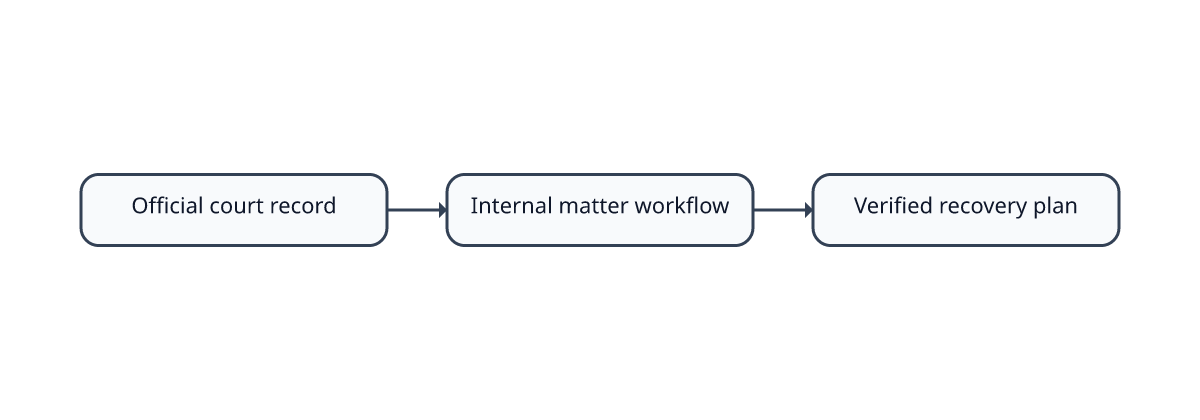
On June 26, 2026, the Administrative Office of the U.S. Courts announced funding for an accelerated initiative to modernize and strengthen the security of the federal Judiciary's case-management and public-access system. The announcement said a temporary increase in electronic public-access fees would begin January 1, 2027 to help fund the work. This is not a new filing rule, and practitioners should consult their own courts for operative requirements. It is, however, a timely reminder that "case management" describes several different systems.
The court maintains the official docket and filing environment. A firm maintains its own matter history, contacts, tasks, notes, deadlines, and copies of relevant records. Treating those layers as interchangeable creates operational risk. A court portal is not a firm's project plan, and a private task list is not the official docket.
Layer 1: The Court's System of Record
Electronic filing and public-access systems contain authoritative court records, subject to the rules and practices of each jurisdiction. Lawyers need documented procedures for account access, filing confirmation, service, fee handling, and retrieving notices. The person completing a filing should preserve the court-generated receipt or notice rather than relying on a browser tab or memory.
Modernization can change interfaces, authentication, fees, and workflows. A small practice should assign responsibility for monitoring official notices and updating its procedure. The safest source is the relevant court or the U.S. Courts website, not a third-party summary.
Layer 2: The Firm's Matter Workspace
Internal case management serves a different purpose. It should answer practical questions: What happened? What is due? Who owns the next action? Which source supports the date? A useful record links an internal deadline to its source, such as an order, rule, or filing notice, and records who verified it.
That distinction matters when information changes. If a hearing is continued, the team should retain the superseded date, the new date, and the source of the change. Replacing one calendar entry without history can erase the audit trail needed to understand a missed handoff.
Layer 3: Recovery and Continuity
Neither court access nor internal organization eliminates the need for backup. A practice should know which records exist only on a device, which are included in operating-system backups, how encryption is managed, and how restoration is tested. A backup that has never been restored is an assumption, not evidence.
Continuity planning also includes access. If the primary lawyer is unavailable, can an authorized colleague identify urgent deadlines without sharing credentials improperly? Are filing receipts and source documents stored with the matter? Is there a written escalation path for a court-system outage?
Operational rule: Record the official source for every critical date, preserve filing receipts, keep internal ownership visible, and test the recovery path before an emergency.
A Five-Minute Matter Audit
- Open one active matter and identify the source for its next critical date.
- Confirm the court receipt or order is stored with the matter record.
- Check whether the assigned owner and next action are explicit.
- Verify that a second authorized person could understand the status.
- Confirm when the relevant backup was last restored successfully.
Docketloom is designed around local matter organization for solo practitioners: structured cases, contacts, tasks, and deadlines without requiring a vendor-hosted matter database. That architecture can reduce one category of third-party exposure, but it does not replace court systems, legal judgment, calendaring procedures, or a tested backup plan.
The Judiciary's modernization initiative is a useful external signal. As official systems evolve, firms should make their own boundaries clearer: courts hold the authoritative docket; the practice holds its operational context; and both require disciplined verification.
This post is for informational purposes only and does not constitute legal advice.