Bankruptcy Filings Rise 12.2%: Intake and Deadline Practices for a Busier Docket
The U.S. Courts reported a 12.2% annual increase in bankruptcy filings. A busier docket is a useful moment to review matter-intake and deadline-control hygiene — not to draw legal conclusions from volume alone.
On July 28, 2026, the U.S. Courts reported that total bankruptcy filings reached 608,511 for the twelve-month period ending June 30, 2026, a 12.2% increase from the prior year's 542,529 filings. Business filings rose 16.9% to 26,941, and non-business filings rose 12% to 581,570. The report also included a chapter-by-chapter breakdown. These figures are aggregate national statistics published by the federal Judiciary; they describe volume, not any individual's situation, and they do not create a legal duty or a filing recommendation.
What a filing-volume report can do is serve as an operational signal. When dockets get busier, the cost of a disorganized intake or an unverified deadline goes up. The practices below are general operational hygiene — not legal directives and not a substitute for professional judgment.
What the Numbers Actually Say
The U.S. Courts report is a statistical release, not a rule change. It tells practitioners that aggregate bankruptcy volume is rising; it does not say which chapters are growing fastest in any particular district, whether a given individual has grounds for relief, or what filing timing would be appropriate in a specific matter. Treating the report as context is the right framing: a practice that handles bankruptcy matters may see more inquiries, more concurrent open matters, and more deadline density. That operational pressure is what makes intake and deadline discipline worth reviewing now.
Intake: Capture the Source at First Contact
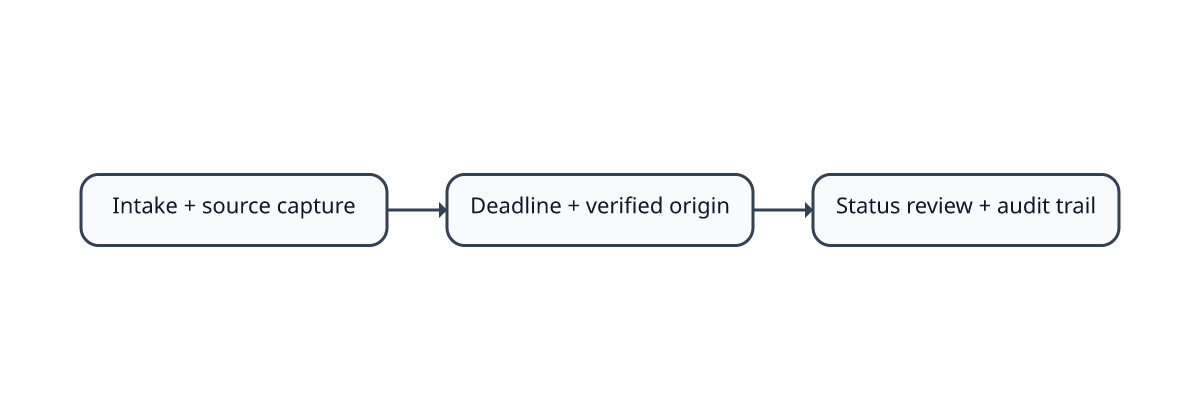
The highest-leverage practice in a busier practice is disciplined intake. When a new matter arrives, the moment of first contact is when information is freshest and when the fewest assumptions have hardened. A structured intake captures the client, the matter type, the referring source if any, and the official document or notice that triggered the inquiry — before the matter is added to the docket.
The key discipline is source capture. Every critical date entered into a matter record should carry a reference to where it came from: an order, a statute, a local rule, a notice, or a court-generated receipt. A date without a source is an assertion; a date with a source is a verifiable record. When volume increases, the cost of tracing back an unsourced deadline grows, and the risk of acting on a wrong date grows with it.
Deadlines: Verify Origin, Preserve History
Deadline control is where a busier docket punishes loose practices. The core principle is that a deadline is only as reliable as its origin. A deadline copied from a colleague's email, a third-party summary, or a calendar reminder is a secondary source. The primary source is the official court document, the controlling rule, or the statute that establishes the date.
When a deadline changes — a continuance, a rescheduled meeting, a court order adjusting a bar date — the practice should preserve both the old date and the new date, along with the source of the change. Replacing a deadline in place erases the audit trail. If a question later arises about why an action was taken on a particular date, the history of the deadline itself is the evidence. Local notifications can help surface approaching deadlines, but a notification is a reminder, not a source; the deadline in the matter record should always trace to its origin document.
Operational rule: Every critical date in a matter record should carry its source. When a date changes, preserve the superseded date, the new date, and the document that authorized the change.
Status Review: Make the Audit Trail Visible
The third layer is status review. In a busier practice, it becomes harder to hold the state of every open matter in working memory. A periodic status review — weekly or at a cadence that matches the practice's volume — should answer three questions per matter: What is the next action? Who owns it? What source supports the next critical date?
An audit trail is what makes that review trustworthy. When each deadline carries its source, each status change carries its reason, and each ownership handoff carries its timestamp, a reviewer can reconstruct the matter's history without guessing. This is also where on-device architecture has an operational benefit distinct from its privacy benefit: when the matter record, the deadline sources, and the status history all live in a single local store, the audit trail is complete and immediately queryable. There is no third-party database to reconcile against, no sync conflict to resolve, and no vendor outage that blocks a status review.
What Docketloom Does and Does Not Do Here
Docketloom is a privacy-first docket and case management app for attorneys. It stores cases, court dates, deadlines, case notes, and case status entirely on-device — no accounts, no cloud sync, no telemetry. It provides the local structure for the practices described above: a case record that can hold deadlines and notes, local notifications that surface approaching dates, and on-device persistence that keeps the audit trail with the matter. It does not replace the official court docket, verify deadlines against court records automatically, or offer legal guidance on filing strategy. The attorney remains responsible for verifying every critical date against the controlling source and for exercising professional judgment on every matter.
A busier bankruptcy docket, as the U.S. Courts report describes, is an operational context. The response to that context is better intake, better deadline discipline, and better status review — not a change in legal standard.
A Five-Minute Docket Audit
- Open one active bankruptcy matter and identify the source for its next critical date.
- Confirm the court order, notice, or rule that establishes that date is stored with the matter record.
- Check whether the assigned owner and next action are explicit and current.
- Verify that a second authorized person could understand the matter's status from the record alone.
- Confirm that any superseded deadlines are preserved with their change history, not overwritten.
None of these steps is a legal conclusion. They are the same operational hygiene that protects any practice when volume rises — the discipline of capturing sources, verifying origins, and preserving history so that a busier docket does not become a less reliable one.
This post is for informational purposes only and does not constitute legal advice.